7. Surface treatments and finishes
Material area: (b) Papers and boards
The following page of notes will cover:
- The application of finishing materials
- Die cutting, spirit varnishing, UV varnishing, laminating
- Embossing, debossing, cropping, folding and binding methods
- Product labelling and symbolic images
Finishing processes
Die cutting:
How it works:
- A sharp steel blade (die) shaped like the net is set into a board
- The die is pressed into the sheet material and cuts out the shape in one movement
- Creasing rules in the same die press fold lines
| Advantages | Disadvantages |
|---|---|
|
|
Uses: Packaging nets, greetings cards, labels
Spirit varnishing:
How it works:
- Solvent based varnish is applied over the printed surface by roller
- The solvent evaporates leaving a hard glossy layer
| Advantages | Disadvantages |
|---|---|
|
|
Uses: Leaflets, packaging, book jackets
UV varnishing:
How it works:
- A UV reactive varnish is applied to the whole surface or selected areas (spot UV)
- The item passes under high intensity UV lamps
- UV light cures the varnish in seconds
| Advantages | Disadvantages |
|---|---|
|
|
Uses: Magazine covers, luxury packaging, business cards
Laminating:
How it works:
- A thin plastic film (gloss or matt) is bonded to the paper or board using heat and pressure, or adhesive
| Advantages | Disadvantages |
|---|---|
|
|
Uses: Menus, ID cards, book covers, food packaging
Embossing and debossing:
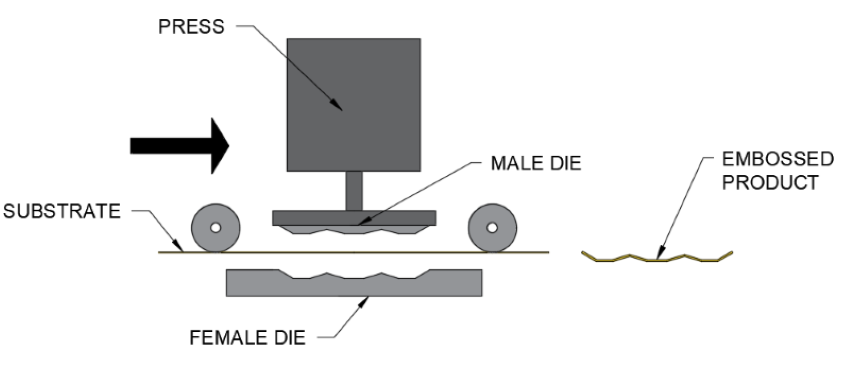
How it works:
- The paper is placed between two matching dies (formers)
- Embossing raises the design above the surface
- Debossing presses the design down into the surface
- Dies can be heated, and can be combined with foil blocking
| Advantages | Disadvantages |
|---|---|
|
|
Uses: Toblerone packaging, wedding invitations, business cards
| Process | Purpose |
|---|---|
| Cropping | Cutting the printed sheet down to its final size using crop marks, removing the bleed area |
| Folding | Machines fold leaflets (e.g. half fold, gate fold, concertina) and book sections accurately |
| Saddle stitching | Folded sheets stapled through the spine (magazines, brochures) |
| Perfect binding | Pages glued into a square spine (paperback books, thick magazines) |
| Section sewn binding | Folded sections stitched together, very durable (hardback books) |
| Spiral / wire binding | Holes punched and a coil inserted, lies flat when open (notebooks, manuals) |
| Foil blocking | Metallic foil pressed onto the surface with a heated die for a premium look |
Product labelling and symbolic images
- Labels and symbols convey messages quickly, often without words, so they work in any language
- Some information is required by law (e.g. ingredients, allergens, safety warnings)
| Symbol | Meaning |
|---|---|
| Mobius loop (three arrows) | The product can be recycled |
| Mobius loop with a % | The percentage of recycled material used |
| Green Dot | The producer has paid towards recycling packaging (not that it is recyclable) |
| FSC logo | Wood fibres come from responsibly managed forests |
| Fairtrade mark | Producers were paid a fair price |
| Tidy man | Please dispose of this carefully, don't litter |
| CE / UKCA mark | The product meets safety standards |
| Age warning (0 to 3) | Not suitable for children under 36 months (small parts) |
| Fragile / this way up / keep dry | Handling instructions on transit packaging |
| Barcode / QR code | Product identification at checkout, links to more information |