6. Specialist techniques and processes
Material area: (b) Papers and boards
The following page of notes will cover:
- Tools and equipment to mark out, hold, cut, shape, drill and form
- Jigs and formers to ensure accuracy
- Deforming and reforming: bending plastics, vacuum forming, press forming, blow moulding
- Laser cutting, 3D printing and CAM machines
- Scoring and folding paper and card
- Assembly, components and joining methods
Wastage and addition
Tools and Equipment:
| Task | Tools and Equipment |
|---|---|
| Mark out | Pencil, steel rule, set square, compass, templates, cutting mat with grid |
| Hold | Masking tape, bulldog clips, cutting mat, safety rule (holds work and guards fingers) |
| Cut | Craft knife with safety rule, scissors, rotary trimmer, guillotine, circle cutter, laser cutter, die cutter |
| Shape | Hole punches, shaped punches, perforating wheel, sanding (foam board edges) |
| Drill | Hole punch, pillar drill for thick laminated board |
| Form | Scoring tool or bone folder, creasing machine, vacuum former and strip heater for plastic laminates |
Cutting Card Safely and Accurately:
- Use a sharp craft knife with a safety rule on a self-healing mat
- Make several light passes for clean edges
- Always cut away from your body
Marking Out:
- Mark lightly in pencil so lines can be removed
- Measure from a straight reference edge and use a set square for right angles
- Use templates to draw the same net or shape many times
- Show cut lines as solid lines and fold lines as dashed lines on a net
Jigs and Formers to Ensure Accuracy:
- A jig holds the work in the same position each time for drilling, cutting or bending
- A former is a shape that material is bent or vacuum formed around to give identical shapes
- Card templates and folding jigs make batches of identical nets quickly
Deforming and reforming
Scoring and Folding Paper and Card:
- Scoring: lightly cutting or pressing a line so the board folds cleanly (use the back of a craft knife or a bone folder)
- In industry a creasing rule in the die presses a crease into the board
- Fold away from the score for a crisp edge
Bending plastics (laminates and sheet):
How it works:
- The bend line is marked on the sheet
- The sheet is placed over a strip heater (line bender) until soft along the line
- It is bent over a former or jig and held until it cools
| Advantages | Disadvantages |
|---|---|
|
|
Uses: Display stands, point of sale holders
Vacuum forming:
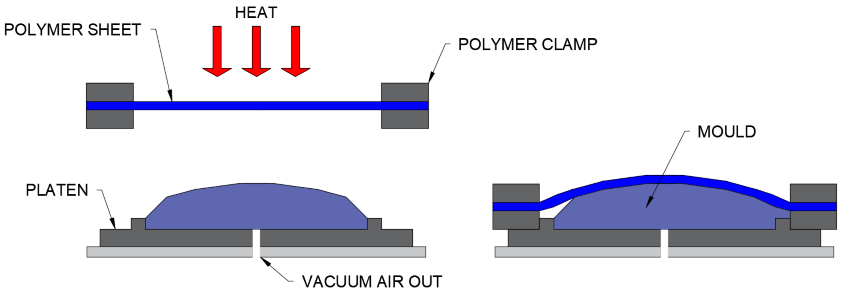
How it works:
- Create mould (draft angles, rounded edges, no undercuts)
- Place the mould on the platen and lower it
- Clamp HIPS sheet and heat until soft
- Raise platen into plastic
- Vacuum pump sucks air out so the plastic takes the mould shape
| Advantages | Disadvantages |
|---|---|
|
|
Uses: Blister packs, packaging inserts, egg box shapes
Press forming / moulding:
How it works:
- Pulp, card or sheet is placed between a matching pair of shaped moulds
- The moulds press together (often heated) to form the shape
- Moulded pulp products are then dried
| Advantages | Disadvantages |
|---|---|
|
|
Uses: Moulded pulp egg boxes, drinks carriers, embossed card
Blow moulding:

How it works:
- Plastic is heated and extruded into a hollow tube (parison)
- The tube is clamped in a two part mould
- Air is blown in so the plastic inflates to the mould shape
- It cools and is ejected
| Advantages | Disadvantages |
|---|---|
|
|
Uses: Plastic bottles used alongside card packaging
| CAM Machine | Use with Papers and Boards |
|---|---|
| Laser cutter | Cuts and engraves card, mount board and foam board accurately. Fumes must be extracted, card can scorch |
| Vinyl/craft cutter (e.g. Silhouette) | Cuts and scores card nets and stickers |
| 3D printer | Prints plastic parts for models and packaging prototypes |
| CNC die cutter / plotter | Cuts and creases nets for prototypes and batches |
Assembly and components
Components for a Particular Purpose:
| Component | Purpose |
|---|---|
| Paper fasteners (split pins) | Pivot points in pop-ups and moving parts |
| Eyelets | Reinforce holes for cords and hanging |
| Velcro and press studs | Reclosable openings |
| Clips and binding combs | Holding sheets together |
| Double sided tape and foam pads | Quick joins and raised layers |
| Joining Method | Permanent or Temporary | Notes |
|---|---|---|
| PVA glue | Permanent | Strong, slow drying, can cockle thin paper |
| Glue stick | Permanent | Clean, quick, for paper |
| Spray adhesive | Permanent or repositionable | Even coat, needs ventilation |
| Hot glue | Permanent | Fast, good for foam board models |
| Double sided tape | Permanent | Clean and instant |
| Slots and tabs | Temporary | No glue needed, can be flat packed |
| Paper fasteners, clips, Velcro | Temporary | Can be opened and reused |